
Senegal Digital UHC: The Challenge of Digitalization
How digital tools can support the CMU in Senegal. Enrollment, interoperability and data protection explained.
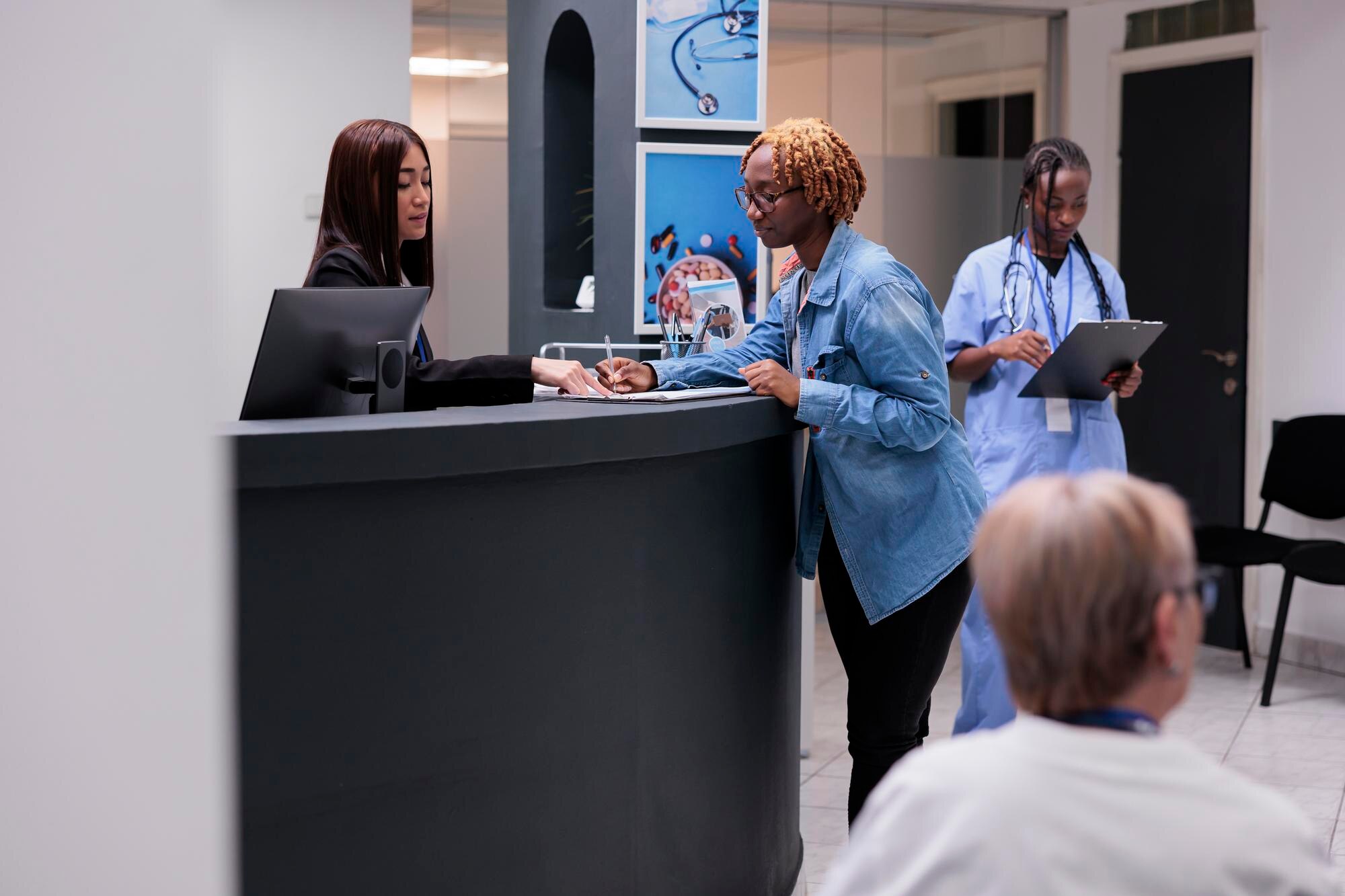
Imagine arriving at a health clinic counter in Thiès or Bouaké, ID card in hand, with no idea whether your coverage is active. You wait while someone searches for your name in a paper register, then you are told to come back tomorrow. Many families know this scene well.
The question of Senegal digital UHC is therefore not only about software: it is about trust, proximity and real access to care. In this article, we analyze how Universal Health Coverage (Couverture Maladie Universelle, or CMU) is being implemented in Senegal and Côte d'Ivoire, and the role digital tools play in enrollment and follow-up.
The State of UHC in West Africa
Let's start with the big picture. According to the WHO and the World Bank (2023), around 4.5 billion people worldwide were not fully covered by essential health services in 2021. The report also shows that the global service coverage index for essential health services stood at 68 out of 100 that year.
The stakes are high, and African governments recognized this early. In the 2001 Abuja Declaration, African Union members, including Senegal and Côte d'Ivoire, pledged to devote at least 15% of their national budgets to health.
This is a political commitment, not an achieved result: you need to compare it with each country's actual spending.
Universal Health Coverage in Côte d'Ivoire: a Structured Rollout
In Côte d'Ivoire, the CMU was established by Law No. 2014-131 of 24 March 2014 and is managed by the National Health Insurance Fund (CNAM). It became operational in October 2019, with an insured-member card and the option to pay by mobile money.
The next challenge is identification. The link with the National Identification Office (ONI), a unique identifier and interoperability with accredited facilities are the keys to a system that truly works for the insured person.
Senegal Digital UHC: a System Under Construction
In Senegal, the CMU was launched in 2013 and is steered by the CMU Agency (ACMU). It relies on creating and structuring departmental and community-based health mutuals, and coexists with targeted free-care schemes: care for children aged 0 to 5, the Sésame plan for older adults, and caesarean sections.
Contribution amounts and benefit packages change according to the regulations in force, so we invite you to check them with ACMU, CNAM or the Official Gazette before taking any step. Each country has its own architecture, and the CMU is not identical from one French-speaking country to another.
Mali, for instance, has its Compulsory Health Insurance (AMO), Burkina Faso its Universal Health Insurance Scheme (RAMU), Cameroon its Universal Health Coverage (CSU) and Benin its ARCH program. Institutions, contributions and benefit packages all differ.
Why Digital Is Essential to the Success of the CMU
Let's be clear from the start: for Senegal digital UHC as elsewhere, technology does not create coverage. According to health economists and international agencies, it lowers the cost of administering it. Identifying beneficiaries, verifying entitlements, billing and fighting fraud all become faster, provided that financing is already solid.
CMU Enrollment: Proximity Before Technology
Think of building a road: without vehicles or travelers, it stays empty. Health mutuals and civil society organizations make the same point: the main obstacle to CMU enrollment is trust and proximity, more than technology.
Community health workers, mutuals and field agents remain decisive in the informal sector and in rural areas. Digitalization without support risks excluding people who have no ID document, no phone or no network coverage.
No need to worry: digital does not mean a smartphone for everyone. In practice, systems can combine service counters, field agents, mutuals, basic phones and mobile money (Orange Money, MTN MoMo, Moov Money, Wave) for contributions, along with USSD and SMS to check your entitlements. This matters in countries where mobile money is often more widespread than bank accounts.
The expected benefits of digital tools are concrete, though they remain to be confirmed in each country:
- reliable identification of insured members through a unique identifier;
- faster verification of entitlements at the entrance of the care facility;
- more transparent billing and reimbursement tracking;
- better detection of fraud and duplicate records.
Managing Beneficiaries Through Interoperability Platforms
A national CMU system relies on several players that do not always speak the same language: civil registries, health insurers, healthcare facilities, mutuals and mobile money operators. Each of these players holds a piece of the puzzle, but none holds the full picture. Without interoperability, each keeps its own records, and the insured person pays the price at the counter.
Imagine each institution speaking a different language: interoperability acts as the interpreter. Specialists recommend a unique identifier and regulated data exchange between these players, so that identity, entitlements and care delivered can be verified without repeated data entry.
Public Health in Africa: Protecting Sensitive Data
Such a system concentrates particularly sensitive data: identity, biometrics, care history. Being digitized does not make that data safe by itself. Security depends on governance, consent, hosting, access management and oversight by data protection authorities.
The legal framework exists: Senegal has Law No. 2008-12 and the Personal Data Protection Commission (CDP), while Côte d'Ivoire has Law No. 2013-450 and the ARTCI. At the regional level, ECOWAS adopted a Supplementary Act on personal data protection in 2010, and the African Union adopted the 2014 Malabo Convention.
Is Being Enrolled the Same as Being Covered?
Another point deserves clarification: being enrolled does not mean being covered. Enrollment must be followed by payment of contributions (or identification as indigent), activation of entitlements and access to an accredited facility.
Likewise, the CMU does not mean totally free care: it relies on mechanisms of contribution, subsidy and partial coverage.
Case Study: Eyone Serving Public Health
At Eyone Medical, we design interoperability solutions for digital health in West Africa. Founded in 2015, our company brings together more than 100 employees and operates in 3 countries (Senegal, Côte d'Ivoire, Gabon), with 3 offices: Dakar, Abidjan and Libreville.
Our Yone-Wi interoperability engine obtained IHE certification in 2024, a first in Africa. This certification applies to the engine itself, not to the company. It reflects a commitment to international standards, enabling health information systems to talk to each other.
Day to day, our solutions address every link in the care pathway. SI Médical supports hospitals and clinics in managing the Electronic Health Record (EHR). The Medical Passport lets patients keep their health information secure and accessible. Eyassur, for its part, simplifies health insurance management. Every project starts from the same question: how can a health professional or a patient save time without losing control of their data?
Our experience was built step by step. In 2021, 322 private facilities were connected to the IPMs (health provident institutions). In 2023, we won the tender for Senegal's national Electronic Health Record. In 2025, we won the tender for the AMO interoperability platform, which will connect all 177 IPMs.
This platform is not yet deployed: it is part of a drive toward smoother beneficiary management in the service of public health, while respecting data protection. Our role is not to replace mutuals, field agents or healthcare professionals: we want to give them a digital ally.
How Do You Register for the CMU?
The documents required, the contributions and the care covered vary by country and by scheme. Contact ACMU in Senegal, CNAM in Côte d'Ivoire or your health mutual. If you have no ID document or birth certificate, ask a field agent for advice on the options available.
In the End: Digital in the Service of Coverage
As you can see, the success of Senegal digital UHC and of Universal Health Coverage in Côte d'Ivoire does not depend on a single tool. It rests on solid financing, quality care provision, community-level agents and systems able to talk to each other. Digital accelerates enrollment and follow-up, while demanding rigor in data protection. The lesson is simple: technology serves people, not the other way around.
Convenient, isn't it? A better-connected care pathway means fewer repeated trips to the counter for families in Dakar, Abidjan or Libreville. And you, are you ready to make digital health a lever for access to care in your facility?
Contact us today for a personalized demonstration of SI Médical, Medical Passport or Eyassur from our Dakar office. Click here to discover our solutions, and read our full article on health interoperability. For any personal health question, consult a healthcare professional.
Tags
Related Articles
Doctor 2.0: Towards African e-Health

Electronic health records in Senegal: from pilot to national programme
National framework, shared record, Eyone Medical's milestones: where electronic health records stand in Senegal, and what it takes to scale them.
Healthcare interoperability in Africa: the state of digital health in 2026
WHO AFRO, Smart Africa and Senegal's programme: where digital health stands in Africa in 2026, and why interoperability is the common thread.